How to choose the right die for corrugated cardboard packaging
Run length, flute grade, cutting and creasing geometry. A clear guide so the die choice is not the bottleneck on the line.
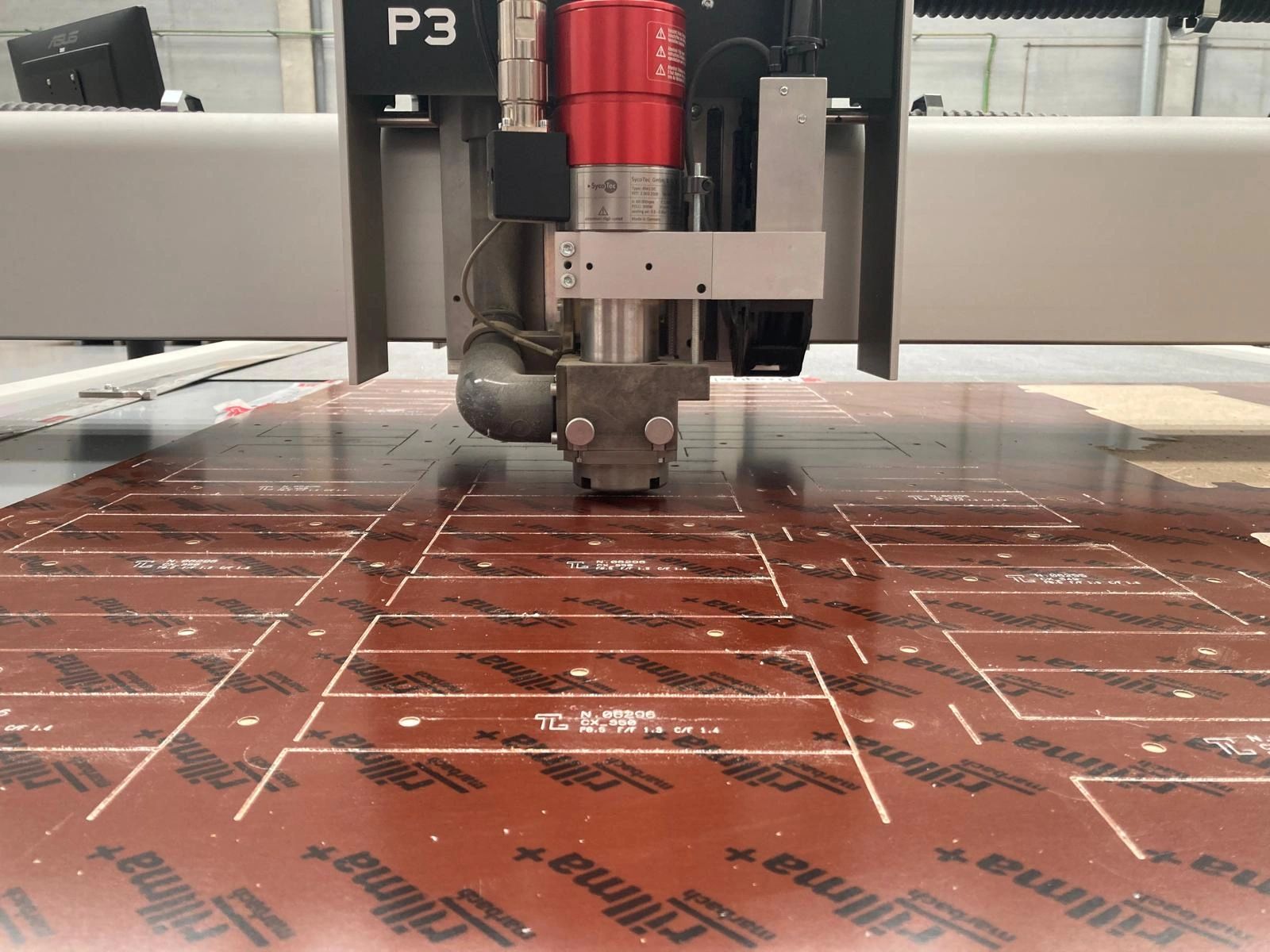
Choosing the right die for a corrugated cardboard packaging line looks, on paper, like a minor technical decision. In practice, it is one of the decisions that has the largest impact on the line's actual productivity, on waste, and on cost per finished unit. This article walks through the variables a production manager or buyer should weigh before requesting a quote, so the die decision does not become what limits the line.
1. Start with run length
The first question is not what the die cuts, but how many units we will produce before changing reference. Run length determines the economic balance between tooling cost and per-unit cost. In corrugated, three typical ranges:
- Short runs (up to 5,000 units). Usually solved with a low-cost flat die. The tooling amortisation does not justify the rotary premium.
- Mid runs (5,000–50,000 units). The zone where both options compete. Look at line speed and changeover availability too.
- Long runs (more than 50,000 units). A rotary die is almost always the right call. Production speed justifies the upfront investment and lowers per-unit cost.
Annual run length matters too: a reference that repeats every quarter changes the amortisation maths entirely.
2. The cardboard flute matters more than it seems
A die optimised for B-flute does not perform the same on E-flute. Flute height, substrate stiffness, and adhesive abrasiveness are three variables that change blade wear and cut quality. Before ordering a die, you should know:
- Flute type and combination: E, B, C, EB, BC, microflute.
- Kraft or test-liner weight, inside and outside.
- Adhesive type and residual starch percentage — affects edge over the medium term.
A die designed for microflute working on BC tends to crush the corrugation rather than cut it cleanly. The downstream consequence is frayed edges and rejects at the end customer.
3. Geometry: cutting, creasing and folding
The die does not just cut. The crease lines determine whether the packaging will assemble on an automatic line without jams. In most production failures we see, the issue is not the cut but a poorly calculated crease. We always recommend validating geometry on actual client cardboard samples before producing serial tooling. A week of CAD/CAM simulation saves months of corrective maintenance.
4. Special finishes and combined operations
If the packaging includes embossing, windows, perforation or hot foil stamping, decide at the outset whether those finishes are integrated into the same die or run as a second station. Integration cuts cycle time but increases tooling cost and maintenance complexity. Separation is more flexible but lowers throughput. There is no universal answer — it depends on the reference mix and the plant's changeover history.
5. Total cost of ownership, not initial price
The most expensive mistake is comparing two quotes purely on the manufacturing price of the die. Real cost includes:
- Tooling manufacture.
- Expected die life (in thousands of units before sharpening).
- Sharpening and maintenance cost.
- Reference-changeover cost (downtime × hourly machine rate).
- Estimated mean waste from dimensional drift.
With those five factors on a spreadsheet, two quotes that looked equivalent can differ by 30–40% in real per-unit cost. Worth running before signing.
6. Frequent mistakes that get expensive
Of the projects that arrive at our shop with inherited problems from a poorly specified die, almost every one repeats one of these five causes:
- Accepting the first quote without asking for expected die life. Two dies at the same price tag can have die lives that differ by a factor of three.
- Not validating creasing on real material. Folding on an automatic line surfaces defects that sample-based QC misses.
- Skipping the maintenance plan. A timely sharpening costs a fraction of a full re-tooling.
- Over-engineering the first run. To validate the market, a simple flat die lets the design iterate before committing to rotary tooling.
- Asking for general tolerances on functional dimensions. If a dimension affects assembly at the end customer, document it as critical.
None of these is technically hard to avoid. They show up when the die decision is rushed and disconnected from the plant analysis.
7. When to bring in external consulting
If the plant has been running for years with dies that perform reasonably well and the reference mix is stable, the die decision can stay in-house. If instead a new line is being opened, the cardboard supplier is changing, or you are entering a customer with different regulatory demands (food, pharma, automotive), it is worth leaning on a partner who documents the process from day one. The investment in consulting hours pays back on the first run that ships without incidents.
How we work at TroqueLab
When a client asks for a die for a new corrugated reference, the first thing we ask for is samples of the material and an annual run-length profile. We then validate geometry on the actual material, not on theoretical simulation. The result: a proposal detailing expected die life and a maintenance plan from day one. If you would like to discuss a specific project, you can explore our services or request a quote, and we will respond within 48 working hours.
Need Custom Die Manufacturing Solutions?
Our team of specialists is ready to help with your project. Get a free consultation.